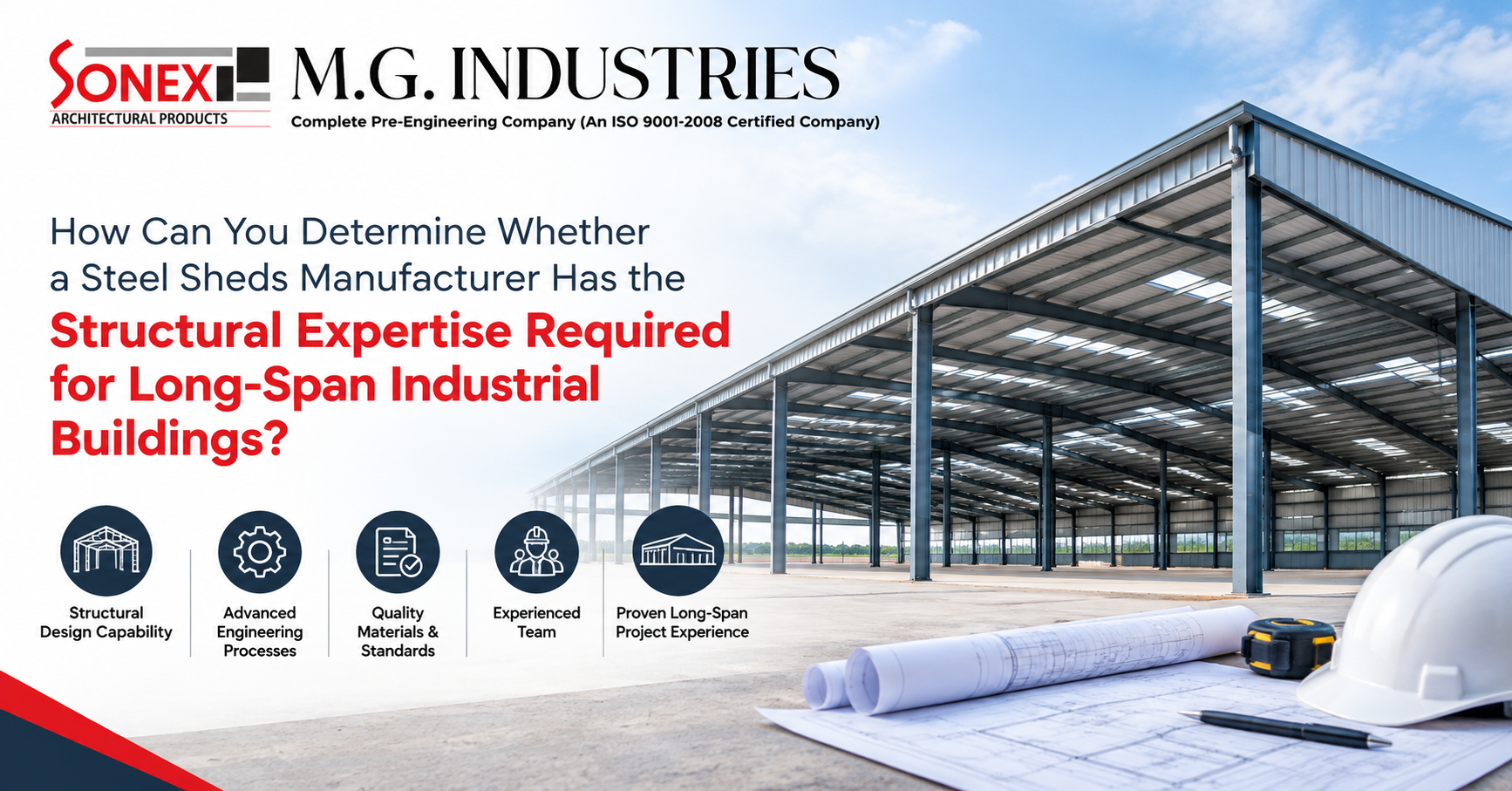
An ordinary steel structure is not enough for long-span industrial buildings. The greater the span length, the more essential it becomes to have knowledge about the structural behaviour, loads, connections, materials, and stability. It thus becomes vital to select the best steel shed manufacturer for companies that plan to build warehouses, manufacturing units, workshops, storage buildings, or any other industrial building.
The manufacturer that possesses the requisite skills can comprehend the requirements of the project before suggesting the appropriate structural solution. Since MG Industries specializes in industrial steel solutions, it is prudent that buyers should assess how technically efficient the manufacturing company is, as opposed to choosing the company only by looks or other factors.
Why Steel Shed Manufacturer Expertise Matters in Long-Span Steel Buildings
The long-span structure is one that covers a large surface area by having few interior columns. Such a structure can provide useful open space for machinery, storage space, movement of people, production processes, material handling processes, among others. On the other hand, constructing such a large span calls for proper structuring.
The structure should be designed to withstand the loads and forces related to the structure itself while remaining stable and functional. The size of the structure, its roof, environment, purpose, and connections are some of the aspects that can affect the final design. This is the reason why it is unwise for a manufacturer to just provide a generic design for all the sheds they sell.
What Should You Check Before Choosing a Steel Shed Manufacturer?
Assessing structural knowledge is simple – one needs to look further than just the completed shed. It involves posing questions regarding the design phase, engineering calculations, materials, connections, manufacturing, and inspections.
1. Ask About the Design Approach
Begin by enquiring about the approach the manufacturer takes for the project. Any professional manufacturer will be able to talk about the structural aspects that come into play, and not just give a simple quote. Enquire whether the design has been made keeping in mind the measurements and applications.
It is important that you know if the structural drawings and engineering detail drawings are done prior to the manufacturing process to avoid any misunderstanding.
2. Understand How Loads Are Considered
Industrial structures may be subjected to various loads. This may consist of dead load, live load, equipment load, if any, and external load. What is more important is not just to know from the manufacturer that the structure is "strong." Rather, you should learn about the identification and inclusion of loads in the structural design.
A manufacturer who knows a lot about engineering should be able to explain the underlying logic of the proposed structure in simple terms that the client understands.
3. Examine the Connection Design
Connections play a very vital role in the design of steel structures. The beams, columns, bracing, and other parts of the structure should function as one integrated system. In the case of long-span structures, the importance of connections becomes all the more significant due to the fact that the forces have to pass through the structure effectively.
The quality of construction is important since even an excellent design needs to be executed properly.
4. Check Material and Fabrication Practices
Structural engineering is more than calculations alone. It also involves making sure that the product will be built right by fabricating the parts correctly. Consider what details have been provided in terms of material specifications, fabrication drawings, cutting, welding, drilling, and assembly. It is good to know how the parts are checked prior to site installation.
Evaluations of this kind should, consequently, take into account engineering and manufacturing skills.
5. Look for Relevant Long-Span Experience
Experience may be able to tell you about how well a manufacturer will be able to handle the practical difficulties of working with such structures. Rather than just asking how many structures the company has built, ask whether the company has experience building similar structures to yours based on certain criteria. The criteria might include span requirements, size, intended usage, structure shape, and site conditions.
The idea is that you find out whether or not the manufacturer knows what kind of project you are dealing with, and not only if it has built metal buildings before.
How Can a Steel Sheds Manufacturer Demonstrate Engineering Capability?
Technical expertise of a manufacturer must be reflected in how the company communicates and documents the project. Make sure that there is a well-structured process in place for design, engineering, detailing, fabrication, and installation. Request proper drawings and technical documentation to get an idea of the project.
You can also ask practical questions like:
Area to Evaluate
|
What to Ask
|
|
Structural design
|
How is the structure designed for the project's requirements?
|
|
Span
|
How will the required clear span be achieved?
|
|
Loading
|
Which applicable loads are considered?
|
|
Connections
|
How are structural connections designed and detailed?
|
|
Materials
|
What material specifications are being proposed?
|
|
Fabrication
|
How are fabrication accuracy and quality controlled?
|
|
Drawings
|
What structural and fabrication drawings will be provided?
|
|
Project experience
|
Has the manufacturer handled comparable industrial structures?
|
|
Installation
|
How are fabricated components intended to be assembled?
|
|
Technical support
|
Who handles engineering-related queries during the project?
|
These answers may provide insight into the approach taken by the manufacturer. A firm that is capable of explaining its engineering process is easier to evaluate than one whose sole focus is on pricing and aesthetics.
Don't Evaluate a Long-Span Structure on Price Alone
Obviously, cost is a major factor, but comparing quotes based on cost alone could be misrepresenting things. Two similar-looking structures from the outside might be quite different from one another in terms of engineering aspects, material specifications, connections, workmanship, and documentation. The initial cost of the two might be quite low for one and not necessarily good value for money.
Instead, compare quotations on a like-for-like basis. Review the proposed structural system, scope of work, materials, drawings, fabrication responsibilities, installation requirements, and other relevant deliverables. This approach helps buyers understand what they are actually paying for and reduces the risk of making a decision based solely on the lowest price.
Questions to Ask Before Finalising Your Manufacturer
Prior to giving the contract for a long-span industrial project, it is essential that you have an elaborate technical discussion with the manufacturer that you have shortlisted. Find out whether the structure proposed has been specifically designed to cater to your needs. Find out who will be designing the structure and the engineering drawings.
Equally, one should consider how the proposed changes will be managed when there is a need for design requirement changes during the design process. At this time, clear communication will avoid unnecessary trouble ahead. Perhaps the most important point is not being hesitant to seek clarification. One does not have to be a structural engineer to evaluate whether or not a supplier takes a technical approach in their work. An efficient team should have no difficulty explaining any technical issues raised.
A Practical Checklist for Selecting the Right Manufacturer
Before making your final choice, consider the following key factors concerning the manufacturer:
- Knowledge of requirements for long-span structures
- Capacity to talk about the loads and stability issues
- Technical documentation of structure and manufacturing
- Appropriate consideration of connection details
- Identification of material and manufacturing specifications
- Industrial project experience
- Proper communication between engineering and manufacturing groups
- Clear scope of supply and responsibilities
- Technical assistance during the project
- An offer for comparison of both technical and commercial aspects
The ideal choice must be one that instills confidence not only about the appearance of the building but also about the structure of the building.
Conclusion
Selecting a Steel Shed Manufacturer for construction of a long-span industrial structure must depend on engineering capability, technical understanding, fabrication procedures, and experience—not necessarily cost or aesthetics. A company that understands the connection between structural design, materials, connections, fabrication, and erection can provide a better perspective on complicated industrial needs.
If structural solutions are to be evaluated in the business, then MG Industries will serve well in making decisions about who to work with. The ultimate decision will depend on the detailed evaluation of the project’s specific requirements. Asking the right set of questions prior to manufacturing helps you find the manufacturer that will have the technical know-how required for your structure.
Frequently Asked Questions
1. What do I need to know about a steel shed for a long span building?
Look for a manufacturer that shows a good understanding of structural design, loading, connections, fabrication, materials, documentation, and long span industrial applications.
2. Why are connections important in industrial steel structures?
Connections transfer loads between structural elements and allow these elements to work together as a single structure. Proper detailing and fabrication are thus an important part of the structural design.
3. How do I compare two steel sheds?
Compare them based on technical capability as well as price. Look at their design approach, experience, materials, documentation, scope of work, and technical support.
4. Should one always choose the lowest quote for a steel structure?
No, that may not be the case. There can be a difference between two quotes with respect to structural scope, materials, engineering, manufacturing process, documentation, and installation. Technical comparability is therefore better.
5. What are the questions that need to be asked before choosing a manufacturer?
Inquire into the structure's design, loading conditions, connection details, materials, manufacturing process, drawings, related experience, installation responsibilities, and technical support. Clear answers can help you make a more informed decision.
 20/6 Nuchem Compound, Mathura Road, Faridabad.
 sonexdecor@gmail.com
 +91 9599213709