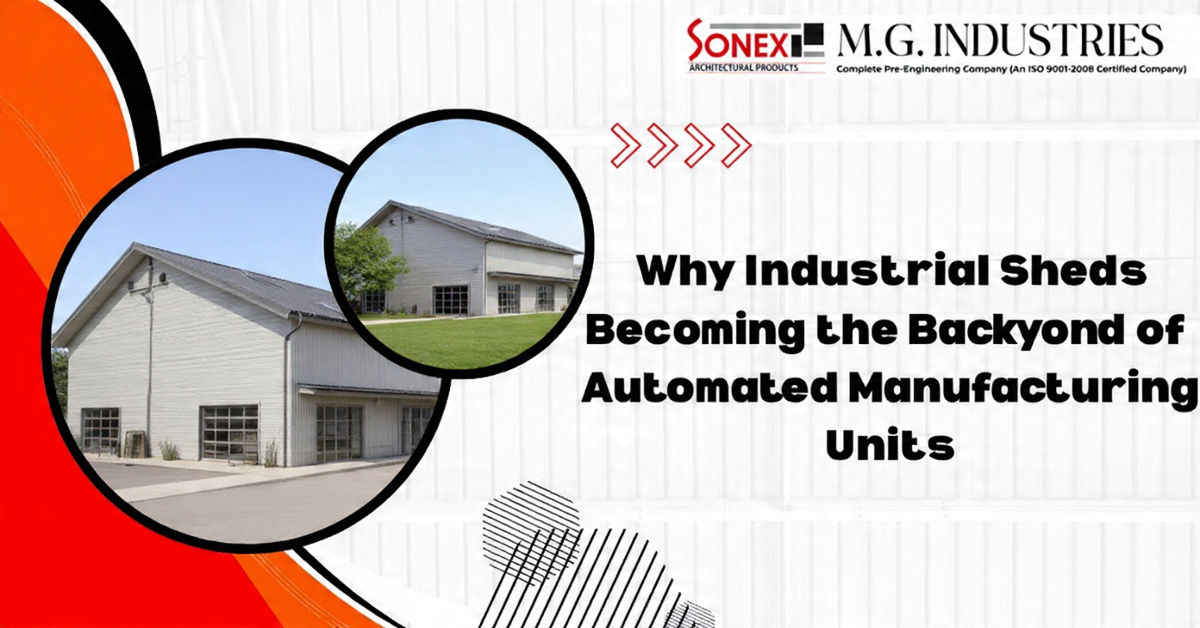
The automation phenomenon is transforming the manufacturing environment at a very high rate. From robotics to AI-driven systems, industries are shifting towards continuous production, with no errors, and at high speed. It is said that much focus is made on machines and technology, yet there is one important factor that is forgotten, and that is industrial sheds, which form the basis of this transformation. The industrial sheds of modern times are no longer mere fabricating or storage areas; they have developed into highly engineered areas that can receive complicated automated mechanisms for safety and efficiency.
Automation requires the appropriate infrastructure
Pneumatic systems need to be in a controlled, spacious, and structurally robust environment. Industrial Sheds Manufacturer offers a designed area with the capacity of housing heavy equipment, robotics, conveyor systems, and robotic-enhanced production lines. These sheds are highly designed to meet the dynamic loads, vibrations, and operational stresses induced by automation. Their open-span designs also do away with internal barriers, hence easing the movement of machines and materials. In the absence of such infrastructure, automation is inefficient, volatile, and unsafe to use.
Streamlined designs to support a streamlined process
The flexibility of industrial sheds is one of the greatest benefits of the latter when it comes to the optimization of the workflow. The concept of automated manufacturing is based on continuous movement of the production process, such that the products move from one unit to another without delays. Sheds used in industries accommodate expansive floors, the location of columns, and layout flexibility. This enables industries to position robotic arms, assembly stations, automated guided vehicles (AGVs), and packaging units in a way that would produce minimal friction and maximize productivity. Sheds used in industry are the best with regard to automation planning in the long term, as the layouts can be updated and reconfigured as processes change.
Large Roof Clearance with Modern Machinery
Vertical machines like robotic cranes, vertical storage towers, automated sorters, and overhead conveyor systems are also commonly used in automated factories. Industrial sheds provide surprising heights in their roofs, and thus, such equipment can be installed in such sheds without structural constraints. Clearance of the roof is also high to facilitate natural ventilation, effective lighting, and upgraded future technology. This makes sure that industries do not need any massive rebuilding of their industries or equipment replacement.
High-quality strength of the heavy-duty equipment
Automated production entails strong machines that cause vibration, pressure, and heavy weights. The sheds in industries are designed with high-tension steel that can withstand these extraordinary forces. The structural stability is long-term since they have rigid frames and durable cladding systems. What is more, the industrial sheds are constructed to be very heavy-weight bearing in order to support various machines like CNC tools, hydraulic presses, and robotic welders. This makes automation run without any danger to equipment and personnel.
Energy Efficiency of Automation at a Low Cost
Recent industrial sheds are designed to accommodate high-energy automated systems with the help of energy-saving structures. These are insulated panels, reflective roofing sheets, natural daylight solutions, and improved ventilation systems. All these elements lead to a decrease in thermal load and energy consumption and contribute to the maintenance of an optimal environment in which machines operate. Automation has to have consistent temperatures, which allow it to be precise and avoid overheating. Industrial sheds are efficient in terms of energy, which lowers the cost of operations but favors the maximum performance of machines.
Improved Safety and Compliance
Automation is fast and accurate, and it demands high standards in terms of safety. The sheds in industries are designed based on the fire code, electrical code, structural code, and environmental codes. Fire-resistant material, emergency exits, smoke detectors, ventilation systems, and pathways of wiring are some of the features that are very crucial in ensuring a hazard-free environment. The sheds also facilitate adherence to the industry regulations, since it will be easier to fulfill the requirements of the compulsory safety audit by companies.
Scalability in Future Expenditure
Automation is not a single investment; it keeps abreast with technology. The scalability offered by the industrial sheds is unparalleled, and the industries are able to scale up operations with minimal disruption. The structure can be easily expanded, new wings can be added, or layouts can be changed because of the modular design options. Industrial sheds are roomy and flexible to allow a company to expand, whether they intend to add more robotic stations, upgrade machines, or expand production capacity. This renders them structures of the future, which underpin long-term automation policies.
Fluid Interaction with Intelligent Technologies
Automated manufacturing relies on connection and live monitoring. Industrial sheds accommodate IoT devices and surveillance cameras, intelligent sensors, and artificial intelligence that enable the central control of activities. Integration is easy through cable trays, structured conduits, and dedicated control rooms. The sheds may also be equipped with solar panels, intelligent ventilation, and automatic lighting, which helps to take the efficiency of the factory to a higher level. The combination of intelligent infrastructure and automated equipment leads to increased performance and improved decision-making.
Perfect in a variety of industries
The industrial sheds can be used across all types of automated industries involving automotive components, electronics, pharmaceuticals, FMCG, textiles, food processing, warehousing, and logistics due to their versatility. All these industries need speed, precision, and consistency, which are natural elements in industrial sheds. The fully customizable designs will have the advantage of ensuring that every shed is customized to meet the automation requirements of the industry.
Economy and ROI in the long term
The construction of a high-quality industrial shed is much more economical compared to the construction of an ordinary concrete building. The advantages of automated industries are time saving, resource conservation, and capital saving due to faster installation, easier customization, and reduced maintenance. These sheds are very durable, and this makes the costs of repair minimal, which in the long run is a payoff. Together with automation, industries have the advantage of speed of production, minimized human error, and optimal use of resources.
Conclusion
Sheds that were used in industries have developed to become high-quality buildings that can sustain the needs of automated production. Their power, space, flexibility, safety concerns, and capability to adapt to new technologies render them essential in the current fast-paced industrialized world. Since automation is on the rise and will keep increasing in the diversification of industries, the industrial sheds will be there to continue supporting effective, secure, and scalable processes. In the case of industries that demand high-quality structural solutions that are capable of supporting automation, a reliable partner such as MG Industries is the best choice, as it promises long performance and performance.
 20/6 Nuchem Compound, Mathura Road, Faridabad.
 sonexdecor@gmail.com
 +91 9599213709