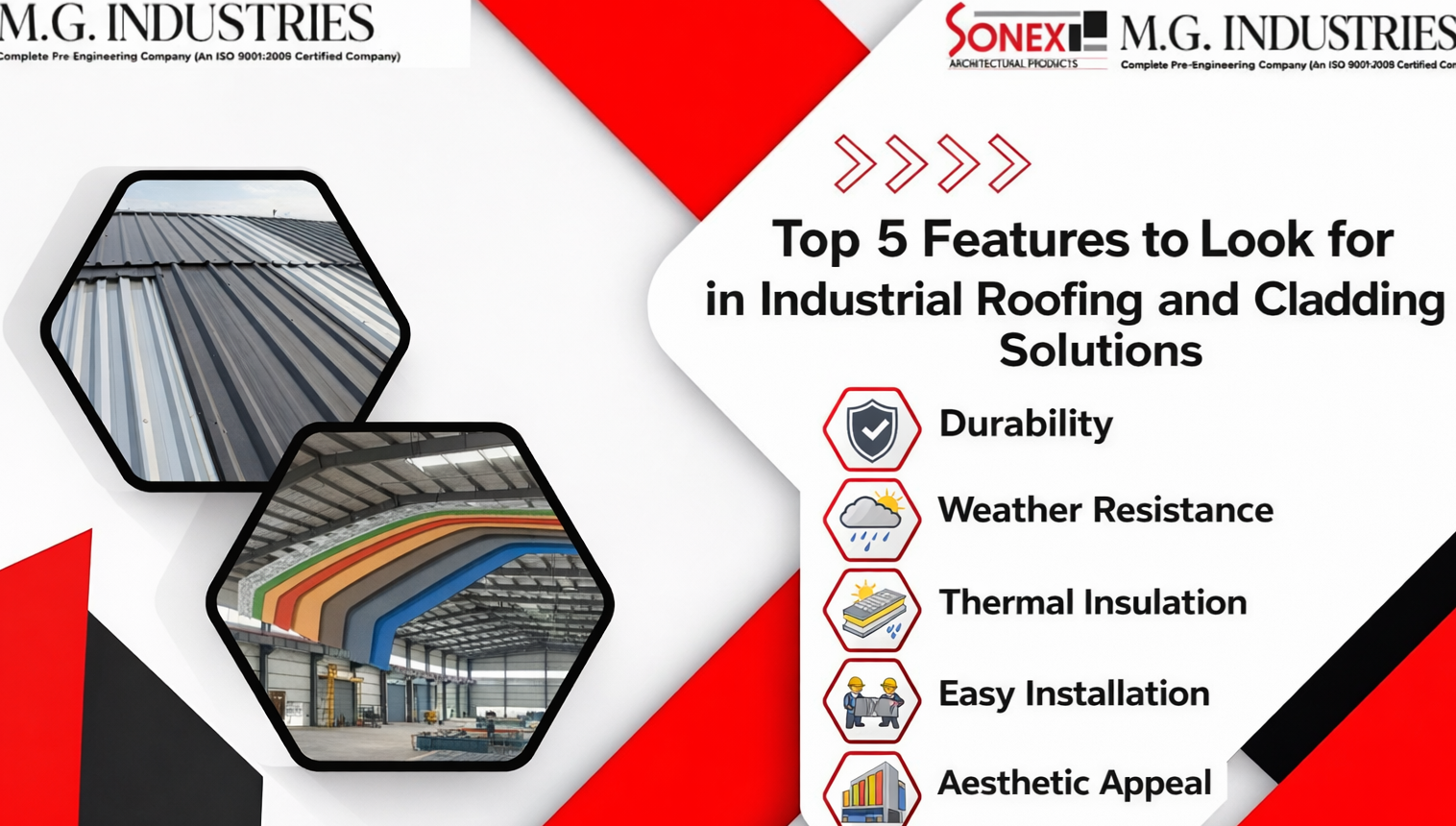
The industrial buildings are not just in need of a basic shelter. As we are exposed to difficult weather, energy prices are increasing, and compliance requirements are becoming stricter, the selection of appropriate Industrial Roofing and Cladding Solutions has become a pivotal choice between the manufacturers, warehouse owners, and infrastructure developers. The system that is right not only safeguards the structure but also enhances efficiency in operations, safety, and cost control in the long run. Knowing the salient features to consider enables the business to invest in roofing and cladding systems that work effectively for decades, as opposed to a few years only.
Structural Strength and Load-Bearing Capacity
Among the greatest qualities of the present-day Industrial Roofing and Cladding Solutions is the fact that they are resistant to massive structural loads. The roofs of industries should be able to carry equipment, maintenance operations, blowing, and, in certain areas, excessive rain or dustfall. Any building with a weak roofing system would jeopardize the security of the whole building.
Designed for Heavy Industrial Conditions
Profiles of strong steel and the use of modern forming methods are used in the design of high-quality roofing and cladding systems so that they are consistent in thickness and strength. The systems evenly distribute loads throughout the structure and ensure that beams and columns are not highly stressed, which also promotes the stability of the structure.
- High wind loads: no deformation is supported.
- Retains form when subjected to the constant stress of operation.
- Offers extended coverage spans and low intermediate support.
Compatibility with Industrial Frameworks
An effective roof design also incorporates a design that is compatible with purlins and trusses, along with primary steel frames. This interrelationship guarantees quicker installation, fewer alignment irregularities, and improved structure execution throughout the building life cycle.
- Minimizes structural differences in the erection process.
- Strengthens the rigidity of a building in general.
- Enhances long-term stability of the framework.
Weather Resistance and Environmental Protection
The weather conditions are subject to constant change, and therefore, weather resistance is an uncompromising aspect of the Industrial Roofing and Cladding Solutions. Roofing materials have to protect the envelope of the building; they should be able to retain the heat produced by the sun, as well as the rain and the pollution.
Protection Against Rain, Heat, and Corrosion
The state-of-the-art roofing and cladding systems make use of coated sheets of steel that are resistant to corrosion and water intrusion. Correct sealing systems are used so that the joints and overlaps are sealed to avoid any leaks, even during extended rainy seasons.
- Eliminates the leakage of water and roof seepage.
- Does not rust in wet or salty conditions.
- Retains an overriding surface under extreme temperatures.
Long-Term Performance in Harsh Environments
The pollution levels in industrial zones are usually higher, hence increasing the degradation of materials. The high-performance cladding systems are made to resist the chemical and air pollutants without elements of deterioration in strength or appearance.
- Less maintenance due to damage as a result of pollution.
- Maintains the quality of finishes and coatings throughout time.
- Prolongs the service life in hostile conditions.
Thermal and Energy Efficiency Performance
Energy efficiency has emerged as one of the priorities in the construction of industries. Properly designed Industrial Roofing and Cladding Solutions contribute significantly to controlling the temperature indoors, which directly affects the consumption of power and comfort of employees.
Thermal Insulation Capabilities
The modern roofing systems have an insulation layer or reflective coating that reduces the level of heat transfer. It assists in the stabilization of indoor temperature so that the use of cooling systems is minimized during seasons when there is high temperature.
- Lowers internal heat gain
- Economizes the use of energy by HVAC systems.
- Makes the shop floor more comfortable for the workers.
Cost Savings Through Energy Control
The businesses are subjected to considerable savings in long-term energy expenses by ensuring better thermal balance. In the long run, the savings created by the effective roofing systems tend to repay the cost.
- Lowers the electricity charges.
- Facilitates sustainability objectives.
- Boosts the efficiency of operations throughout the year.
Ease of Installation and Maintenance
Reliable Industrial Roofing and Cladding Solutions are required to be efficient installations and have minimal maintenance specifications. Delays during the construction process or regular interruptions during maintenance may escalate the project costs and cause an inconvenience in operation.
Faster Installation Without Compromising Quality
Premade roofing and cladding systems are made with accuracy and can be installed faster on-site. This lowers dependency on labor and minimizes the project durations.
- Helps in completing a project at a faster rate.
- reduces work on-site fabrication.
- Eliminates mistakes during installation.
Low Maintenance Requirements
Coatings and long-lasting profiles are of high quality, which means that the necessity of frequent repairs is minimized. The fact that they are easily accessible to inspection and cleaning also increases the ease of these systems.
- Makes fewer repairs with time.
- Makes it easy to conduct routine inspections.
- Reduces the maintenance expenses in the long run.
Aesthetic Appeal and Design Flexibility
Although the performance is essential, the visual appeal is a component of the modern industrial architecture. The current-day Industrial Roofing and Cladding Solutions provide a form of balance between strength and beauty, which allows businesses to preserve a professional and modern look.
Modern Finishes and Color Options
The cladding systems come in a diverse series of finishes and colors that improve the appearance of the exterior of a building. The choices give industries the opportunity to match their buildings with the brand identity and architectural preferences.
- Improves the aesthetics of the industrial buildings.
- Favorable to branding corporate colors.
- Provides a contemporary, sophisticated look.
Design Adaptability Across Applications
Flexible roofing and cladding systems conform to various building shapes and functional needs, whether it is a warehouse, manufacturing unit, cold storage, or logistics hub.
- Can be used in an array of industries.
- It is customizable according to operational requirements.
- Leads to further growth or change.
Conclusion
The choice of appropriate industrial roofing and cladding solutions is a planned move that directly influences the safety, efficiency, and durability of the industrial buildings. Regarding structural strength and weather protection, energy efficiency, and design beauty, all the features are crucial to the reliability of performance over the years. Companies with high-quality systems save on maintenance expenses, enjoy better operational comfort, and increase the value of assets. Having a long experience in the supply of strong roofing and cladding systems based on the industry needs, MG Industries has managed to assist the business with solutions that are not only accurate in their engineering but also durable and of long-term value.
 20/6 Nuchem Compound, Mathura Road, Faridabad.
 sonexdecor@gmail.com
 +91 9599213709