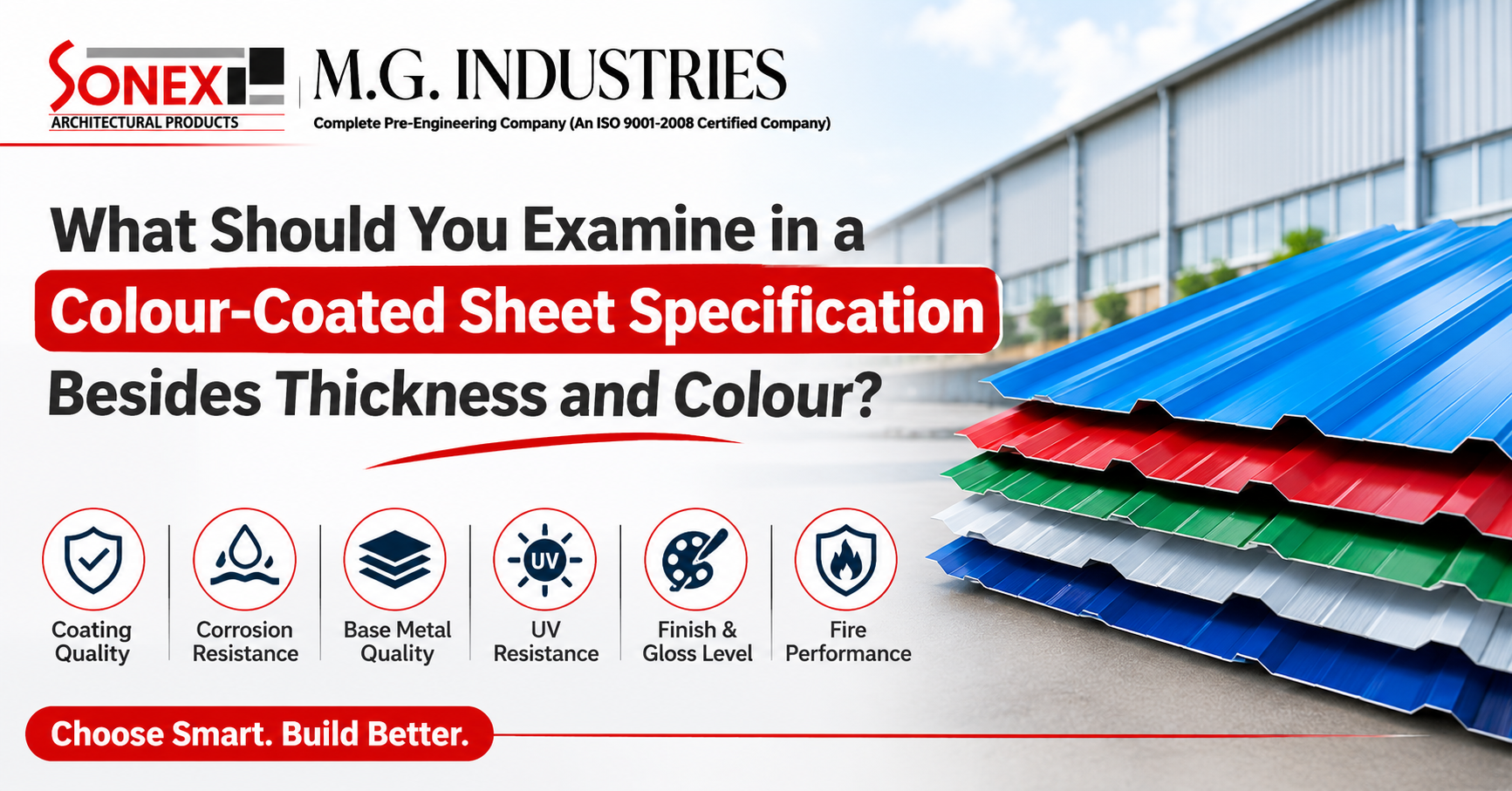
Thickness and color are the first two parameters that come into consideration when choosing roofing or cladding material. However, these two are not sufficient to determine the performance of a color-coated sheet over its lifetime. Other parameters such as the nature of the coating, nature of the underlying metal, corrosion resistance ability, adhesive property of the paint, etc., also have an important role to play. Selecting the appropriate Color Coated Sheet Manufacturer Delhi NCR is also crucial since the performance depends on the manufacturing process of the material.
This knowledge of technical facts at MG Industries can assist customers in making proper judgment when buying colour-coated sheets for industrial purposes.
Why Do Colour-Coated Sheet Specifications Matter?
Color-coated sheets are commonly used for roofs, walls, warehouses, industries, industrial buildings, and commercial buildings. Each of these uses exposes the sheet to varied climatic and working environments. A color-coated sheet in an industrial area will have dust, moisture, and contaminants. A color-coated sheet used in roofing will be exposed to sunlight and rainwater. The product specification sheet gives details about the manufacturing process and performance attributes. It would be wise to consider other factors than thickness and color to determine the suitability of a product.
For instance, there can be two sheets of the same thickness and surface color that differ in the protective film, quality of the steel, and painting system. All of these aspects affect the corrosion resistance, appearance, and durability of the sheet. That is why it is always better to look at all the technical specifications before buying.
1. Check the Base Metal Grade and Composition
The base metal is one of the critical materials that make up the colour-coated sheet. The base metal is the base of the coating process. The buyer needs to confirm the type of steel that is stated in the technical specification. There are different types of steel that cater to various needs like construction, roofing, fabrication, and bending or forming.
It is important that the required steel grade meets the purpose of using the metal sheet. For example, the roofing profiles might need sheets with good forming properties, while certain industrial applications might need steel sheets with good mechanical strength. It is also necessary to understand if the producer specifies either the grade of the base metal or only the sheet characteristics. This will make it easier to compare different products and find out whether the chosen sheet suits the needs of the project.
2. Examine the Coating Type and Coating Thickness
The metallic coating is very significant in terms of safeguarding the steel substrate from corrosion. It serves as a barrier and contributes to enhancing the corrosion resistance of the material. The choice of coating depends on the product, where either zinc or aluminum-zinc coating can be used. The two coatings have different properties and need to be selected based on the application. The buyer needs to consider the following:
- Coating type: Find out whether the coating on the sheet consists of zinc or an alloy of aluminium and zinc.
- Weight of coating: Check the weight of the coating that is usually provided in terms of g/m2.
- Uniformity of coating: Find out whether the protective coating is provided evenly on the surface of the sheet.
- Compatibility of the coating: Check whether the coating is suitable for the environment for installation of the sheet.
While a more extensive coating thickness would provide better protection where appropriate, it all depends on the proper application. There is a need for buyers not to make the assumption that all coating systems provide equivalent levels of protection.
3. Review the Paint System and Coating Performance
The paint systems not only determine the look of the color-coated sheets but also give extra protection from exposure to the environment. A normal color-coated sheet has a primer layer as well as a topcoat layer, and the back side may also have another layer depending upon the specifications. Potential buyers need to understand these important aspects before ordering them.
- Topcoat thickness: The thickness of the top paint coating affects surface protection and appearance. Look for the stated dry film thickness (DFT), usually in microns.
- Primer coating: The primer helps with paint adhesion and is part of the total coating system. The details of the primer must be well defined in the product description.
- Back coat: The coating on the back side is also relevant, especially when the panel is applied to roofs and claddings, where exposure to the elements can occur from both sides.
- Type of paint: Various paints have various resistance to sun exposure, moisture, and weathering. Choice of paint should depend on project site and application. A properly defined paint system makes comparison of products easier.
4. Evaluate Corrosion and Weather Resistance
It is also possible to mount color-coated sheets at locations where there are varied climates. There will come a time when the effect of rain, humidity, sunlight, or the pollution of the atmosphere may start to wear away the surface of the sheet unless the sheet is well-protected against such effects. It is because of this that it becomes very essential for consumers to think about corrosion and weather resistance. One must check beforehand if the technical data sheet includes information regarding these two factors.
In the case of any construction work in coastal or very humid environments, corrosion protection becomes essential. Likewise, constructions which are likely to be subjected to intense sunlight need a painting system with adequate UV resistance. It would be wrong to think that every color-coated sheet will have the same degree of environmental protection. These factors affect the efficiency of the coating system. It is always advisable to discuss these with the suppliers.
5. Check Paint Adhesion and Surface Finish
The paint coating on the sheet must have good paint adhesion properties while handling, transporting, installing, and using the sheet. In case of poor paint adhesion, there could be peeling, flaking, or damage to the surface. Paint adhesion becomes very critical for sheets that require bending or profiling operations. If the paint coating does not survive the processing, there will be cracks or defects on the surface. See if the product specification mentions the paint adhesion and flexibility test results.
The surface finish needs to be inspected as well. Check for even coating, an even appearance, and the absence of any visible scratches, bubbles, or blotches. A thorough surface inspection prior to installation can help detect any quality problems and avoid replacing any material unnecessarily.
6. Understand the Mechanical Properties of the Sheet
The mechanical properties will describe the manner in which the metal reacts to certain physical forces applied to it. This is vital when using pre-coloured sheets for roofing, cladding and construction purposes. A number of properties include:
- Yield strength: It is the stress at which the material starts to undergo permanent deformation.
- Tensile strength: It is the maximum amount of stress that the material can take before breaking.
- Elongation: It is the ability of the material to elongate before breaking.
- Bendability: It helps in deciding whether the sheet can be bent to the desired shape without damaging the coating.
All these properties must be taken into account with regard to the requirements of the project. For example, roofing sheets will require proper flexibility for profiling, whereas some industrial applications may have special strength requirements. Choosing a sheet simply because of how it looks will not consider these important requirements.
7. Verify Dimensional Accuracy and Sheet Tolerances
Dimensional accuracy will directly impact the installation and fitting of color-coated sheets. Any slight measurement inaccuracies may make it hard to fit several sheets at once. The following should be considered by buyers:
Specification
|
What to Examine
|
|
Width
|
Confirm the actual sheet width and required dimensions.
|
|
Length
|
Check whether the sheet length matches project requirements.
|
|
Thickness tolerance
|
Review the permitted variation in thickness.
|
|
Flatness
|
Check for unwanted bends, waves, or surface irregularities.
|
|
Profile dimensions
|
Verify rib height, spacing, and shape for profiled sheets.
|
Proper sizing will ensure that the right alignment is maintained while reducing unnecessary adjustments during the installation process. It is also helpful to find out whether the quoted width refers to the total width or the effective coverage width, especially when calculating the amount of material required for the roof.
8. Ask About Manufacturing Standards and Quality Testing
The supplier in question ought to be able to offer appropriate technical information regarding the production process and product quality. The buyers need to inquire if the sheets have been produced in accordance with Indian and international standards for this kind of product. Test results as well as product inspection reports may also be requested if available. These may include the following:
- Measurement of base metal and coating thickness.
- Film thickness measurement of paint.
- Adhesion and flexibility test.
- Mechanical properties test.
- Surface finish and dimension check.
This will give you an understanding of the product more than relying on its description and its looks. When choosing between different suppliers, ensure that you choose the one that gives technical details and specifications. This will make it easy for you when buying the product.
9. Consider Packaging, Handling, and Delivery Conditions
A color-coated sheet, even if it is produced in the right way, can suffer surface damage if it is not handled and transported properly. There could be scratches, dents, moisture, and even improper stacking that could cause some harm to the sheets even before they reach the place of installation. This could increase work and could affect the aesthetics of the building too. It is wise to enquire about all these aspects regarding packaging, protection, stacking, and transport of these sheets.
However, proper storage is equally significant. The materials must be stored under ideal conditions and in a manner to prevent any unnecessary wetness exposure before being installed. Proper storage of the materials keeps the sheets in their initial state.
Why Choosing the Right Colour Coated Sheet Manufacturer Delhi NCR Matters
Technical specifications become useful only when the supplied product complies with its promises in that regard. For this reason, selection of a credible manufacturer becomes one of the crucial aspects of purchase. A trustworthy Color Coated Sheet Manufacturer in Delhi NCR should be able to specify the base metal grade, coating process, paint specifications, and dimensional tolerances of the product.
Rather than comparing vendors based on price alone, look at the whole product offering. Just because a sheet is less expensive does not mean that it is automatically better suited for the job when the coating system, mechanical characteristics, and specs fail to meet project demands. Prior to submitting an order, tell them what you require and request their technical specs of the suggested material.
Conclusion
Choosing color-coated sheets involves more consideration than looking at thickness and color. Metal base alloy, metallic coating weight, paint system, corrosion resistance, mechanical properties, dimension tolerance, and quality testing all factor into the selection process for determining whether or not the material is suitable for the job. Taking time to go through this will help you make wise choices when purchasing the material. At MG Industries, we understand the value of proper material selection according to project needs. During the assessment of a Colour Coated Sheet Manufacturer Delhi NCR, it is necessary to pay attention not only to aesthetic considerations but also to the technical aspects such as applicability and specification.
Frequently Asked Questions
1. What other than thickness is the most important specification in colour-coated sheets?
Base metal grade, metallic coating mass, and paint system are among the most important specifications. They affect strength, resistance to corrosion, and surface durability.
2. What is the meaning of coating mass in colour-coated sheets?
Coating mass is the weight of the metallic protective layer that is applied to each surface area of the sheets. The coating mass is normally measured in grams per square meter (g/m2).
3. Why is the thickness of paint an important specification in colour-coated sheets?
Paint thickness affects the protective quality and appearance of the sheet. It is important to consider the top coat, primer, and back coat specifications of the paint system.
4. In what ways may the purchaser be able to determine the quality of colour-coated sheets?
The buyer could refer to the technical data sheet of the sheets, study the material specifications of the sheets, examine the surface finish of the sheets, and refer to quality test reports. Also, they could check the dimensions and coating of the sheets.
5. In what way may a suitable colour-coated sheet manufacturer in Delhi NCR be chosen?
The buyer could compare the manufacturers depending on the material specifications, coating of sheets, quality test reports, and suitability of the product.
 20/6 Nuchem Compound, Mathura Road, Faridabad.
 sonexdecor@gmail.com
 +91 9599213709