Within industrial complexes, logistic zones, and manufacturing sites, a paradigm shift is gradually beginning to be witnessed in terms of building design and erection. Businesses that used to favor conventional brick-and-mortar construction are now switching to better options, which are faster, more economical, and much more scalable. Leading this revolution are Fabricated Buildings for Industrial Purposes. The old paradigm entailed high uncertainty in terms of cost and time, but today, businesses emphasize speed, efficiency, and durability.
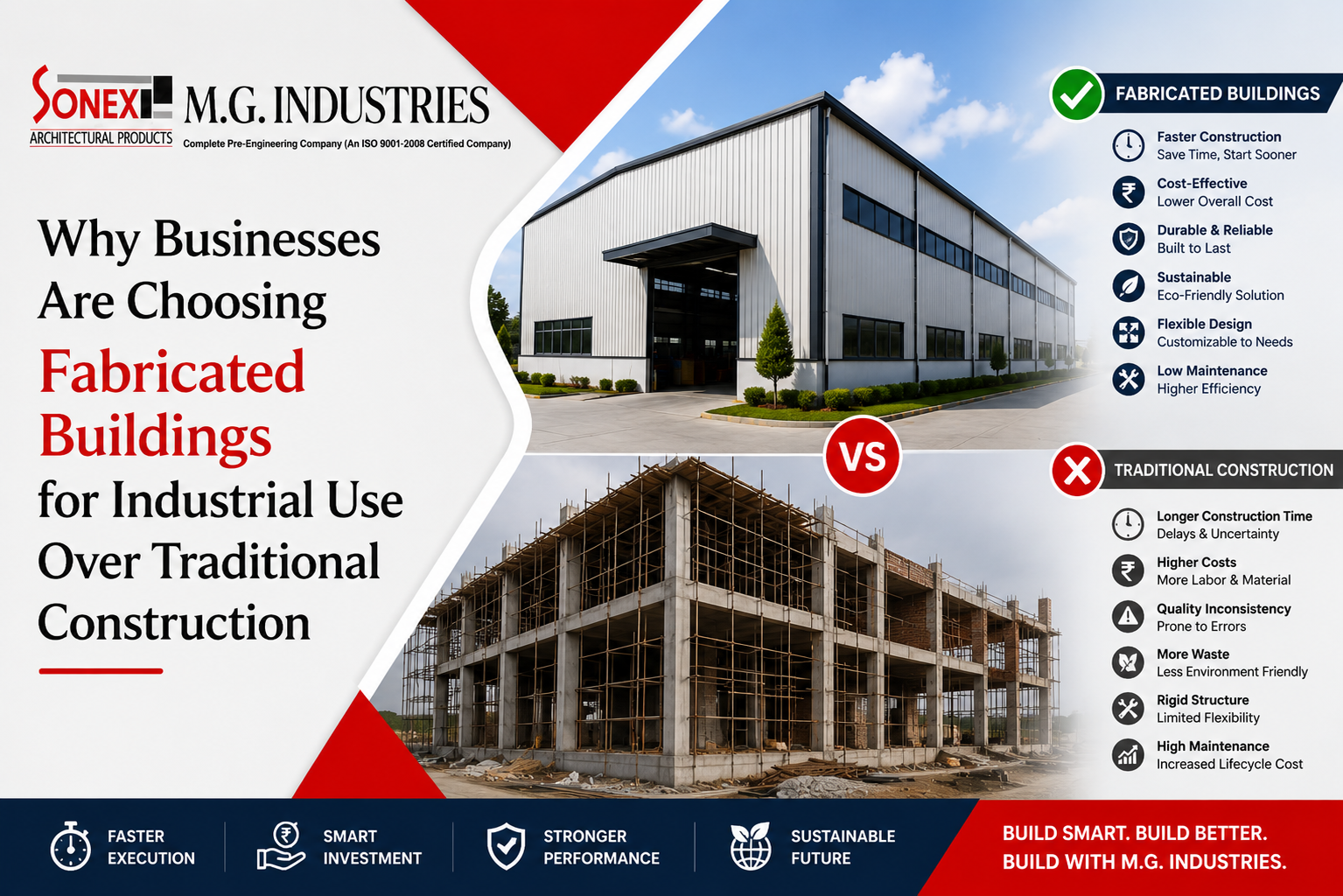
Why Fabricated Buildings for Industrial Use Have to Replace Traditional Methods of Construction
Changes are taking place in the construction sector because companies do not want any delays, additional costs, or inefficiency. In the case of traditional construction methods, these problems arise due to excessive labor required and uncertainties.
However, in Fabricated Buildings for Industrial Use, structures are created in a manufacturing environment and assembled on site. Because of this process, the construction time frame is shortened substantially.
For instance, a warehouse that used to take 8 to 12 months to build can now be assembled within a much shorter period if steel prefabricated structures are used. It is not only faster but more reliable as well.
These are industries like automotive, FMCG, logistics, textiles, and heavy engineering that opt for this process.
How Fabricated Buildings for Industrial Use Improve Efficiency and Performance
One of the strongest advantages of modern industrial fabrication is operational efficiency. These structures are engineered with precision, ensuring every component fits perfectly during assembly.
Key efficiency benefits include:
- Faster project completion timelines
- Reduced on-site labor requirements
- Minimal construction waste
- Controlled manufacturing quality
- Improved structural accuracy
- Easy expansion and modification options
Unlike traditional buildings, where environmental conditions can affect construction quality, fabrication ensures uniformity regardless of site conditions.
In large-scale industrial projects, this consistency plays a critical role in reducing operational delays and improving long-term building reliability.
Cost, Durability, and Long-Term Value of Fabricated Buildings for Industrial Use
Cost efficiency is one of the most important decision factors for any industrial project. While initial investment may appear similar in some cases, the lifecycle cost of fabricated structures is significantly lower.
Cost Advantages
- Reduced construction delays lead to lower overhead costs
- Lower maintenance requirements over time
- Reduced material wastage
- Predictable budgeting without major surprises
Durability Advantages
Modern fabricated structures are built using high-grade steel and advanced coating systems, ensuring long-term resistance to:
- Corrosion
- Weather conditions
- Heavy operational loads
- Industrial environmental stress
Comparison with Traditional Construction
Traditional construction often requires frequent repairs and structural reinforcements over time. In contrast, Fabricated Buildings for Industrial Use are designed for durability from the start, reducing long-term maintenance burdens.
This makes them especially suitable for industries that require uninterrupted operations and high structural reliability.
Why Businesses Are Shifting Toward Fabricated Buildings for Industrial Use?
The decision to adopt fabricated construction is no longer limited to cost savings. It is now driven by strategic business needs.
Industries prefer fabricated structures because they offer:
- Scalability for future expansion
- Faster return on investment
- Better space utilization
- Consistent quality standards
- Flexibility in design customization
For growing businesses, speed-to-market is critical. Whether it is a new production facility or a distribution center, construction delays can directly impact revenue. Fabricated solutions solve this problem by significantly reducing build timelines.
Another important factor is adaptability. As business needs change, these structures can be modified, extended, or reconfigured with minimal disruption.
How to Choose the Right Solution for Your Industrial Project
Selecting the right fabrication system is a crucial decision that affects long-term performance.
Here are key considerations:
Engineering Capability
Ensure the structure is designed using advanced engineering standards and load calculations suited for industrial use.
Material Quality
High-grade steel and protective coatings ensure durability and long-term resistance against environmental stress.
Customization Options
Every industry has unique requirements. The structure should support layout customization, ventilation needs, and future expansion.
Installation Expertise
Even the best-designed structure can fail without proper installation. Skilled execution ensures structural integrity.
Manufacturer Experience
Experienced providers bring technical knowledge, better execution planning, and proven project delivery capability.
Making the right choice at this stage ensures long-term operational efficiency and reduced maintenance costs.
The Future of Industrial Construction with Fabricated Buildings for Industrial Use
The future of industrial infrastructure is moving toward speed, precision, and sustainability. With rising demand for logistics, manufacturing, and warehousing facilities, traditional construction methods are becoming less practical.
Fabricated Buildings for Industrial Use represent a shift toward smarter construction practices where efficiency and scalability take priority over outdated methods.
Sustainability is also becoming a major factor. Prefabrication reduces material waste, improves energy efficiency in production, and minimizes environmental impact compared to conventional construction.
As industries continue to expand, this approach will become the standard rather than the alternative.
Final Thoughts
Modern industrial growth demands construction solutions that are fast, reliable, and future-ready. Fabricated Buildings for Industrial Use deliver all three by combining engineering precision with efficient execution and long-term durability. From warehouses and factories to large-scale production facilities, these structures are transforming how industries build and expand. Businesses that adopt this approach benefit from reduced timelines, lower costs, and improved operational flexibility. Companies like MG Industries continue to support this transformation by delivering high-quality fabricated building solutions designed for long-term industrial performance and scalability.
 20/6 Nuchem Compound, Mathura Road, Faridabad.
 sonexdecor@gmail.com
 +91 9599213709