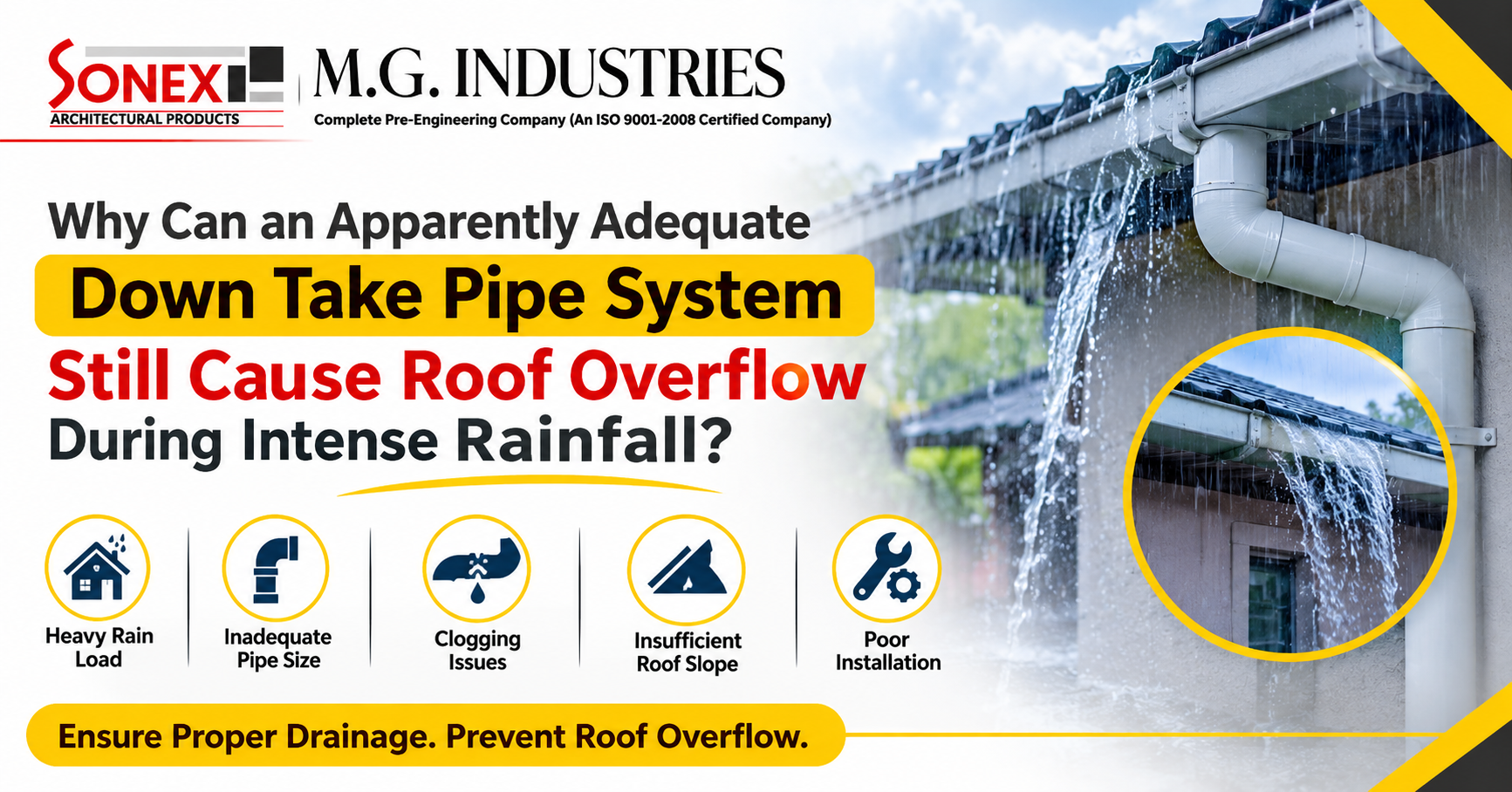
A roof drainage system may appear properly installed, with sufficient pipes and visible outlets, yet still struggle during heavy rainfall. Water begins collecting on the roof, drainage slows down, and overflow can occur even when the system seems adequate. This usually happens because drainage performance depends on more than the number or size of pipes. Pipe capacity, roof area, outlet positioning, blockages, water flow, and installation quality all influence how effectively rainwater is removed.
For builders, contractors, architects, and property owners, understanding these factors is important when selecting a Down Take Pipe Manufacturer in Delhi NCR. MG Industries focuses on the importance of suitable pipe selection and reliable drainage components for building projects. A well-planned down take pipe system should handle expected rainfall conditions while allowing water to move efficiently from the roof to the designated drainage point.
Why Does Roof Overflow Happen Despite an Adequate Down Take Pipe System?
An apparently adequate drainage arrangement does not always mean that the complete system can handle intense rainfall. A pipe may have the required diameter, but the overall drainage capacity can still be limited by other components. For example, if roof outlets cannot collect water quickly enough, rainwater may accumulate before reaching the downpipe. Another issue is the difference between normal rainfall and sudden heavy showers. A drainage system that works properly during moderate rain may experience difficulty when a large volume of water reaches the roof within a short period. If the drainage design does not account for peak rainfall intensity, water can collect faster than it leaves.
Roof overflow can also occur when the drainage route contains unnecessary bends, poorly positioned connections, or obstructions. These conditions affect the movement of water and may reduce the effectiveness of an otherwise suitable pipe arrangement.
How Can Pipe Diameter and Drainage Capacity Affect Roof Water Flow?
Pipe diameter plays an important role in determining how much rainwater a down take system can carry. However, selecting a larger pipe does not automatically solve every drainage problem. The correct size depends on the roof's catchment area, expected rainfall intensity, number of outlets, and the layout of the drainage network. If pipes are undersized, they may struggle to carry the incoming water during intense rainfall. This can result in water backing up near the roof outlets or overflowing through low points. On the other hand, choosing pipe dimensions without considering the complete drainage arrangement may lead to an inefficient design.
The drainage capacity should be evaluated as a complete system rather than as an individual pipe specification. Roof outlets, horizontal connections, vertical pipes, and discharge points must work together. A few important factors to evaluate include:
- Roof catchment area: Larger roof surfaces collect more rainwater and generally require greater drainage capacity.
- Rainfall intensity: Short periods of intense rainfall can create higher drainage demands than prolonged light showers.
- Pipe diameter: The selected diameter should support the expected water flow.
- Number of outlets: Their quantity and placement influence how quickly rainwater enters the drainage network.
- Discharge arrangement: The final outlet should allow collected water to move away without unnecessary restrictions.
A suitable Down Take Pipe Manufacturer in Delhi NCR can help project teams evaluate available pipe options according to the intended application and project requirements.
Can Poor Roof Outlet Placement Lead to Water Accumulation?
Yes. Even when the down take pipes have sufficient capacity, incorrectly positioned roof outlets can prevent water from entering the drainage system efficiently. Rainwater naturally moves according to the roof's slope and surface levels. If outlets are placed away from natural collection points, water may remain trapped in certain areas. Flat roofs and roofs with multiple levels can be particularly challenging because their drainage arrangements require careful planning. For example, a large commercial roof may have several sections with different slopes. If the outlets are concentrated in one area, water from distant sections may take longer to reach them. During intense rainfall, this delay can contribute to temporary water accumulation and overflow.
The placement of outlets should therefore be considered during the building design stage. Roof slopes should direct water towards suitable collection points, while the number of outlets should match the expected drainage requirement. Secondary drainage arrangements may also be considered where appropriate. These provide an additional route for water when the primary drainage system cannot handle the incoming flow. Their design should follow applicable building requirements and project conditions.
How Do Blockages and Maintenance Problems Reduce Down Take Pipe Performance?
A drainage system can lose its effectiveness over time because of dirt, leaves, plastic waste, dust, and other debris. These materials may collect around roof outlets, strainers, or inside accessible sections of the drainage network. Even a partial blockage can restrict water movement. During ordinary rainfall, the remaining opening may be sufficient to carry water away. However, when rainfall becomes intense, the restricted passage can create a bottleneck. The problem may become more serious when maintenance is neglected. Roof drainage systems are exposed to outdoor conditions throughout the year, making periodic inspection necessary. Property owners and facility managers should pay attention to:
- Leaves and debris collecting around roof outlets.
- Visible cracks or damage in exposed pipe sections.
- Loose connections between drainage components.
- Water leakage around joints.
- Unusual water accumulation near roof drainage points.
- Blockages in accessible discharge areas.
Cleaning roof outlets before and during the monsoon season can help reduce the risk of avoidable drainage problems. Inspections after heavy rainfall are also useful for identifying damage or restrictions that may not be visible during dry weather.
Can Incorrect Pipe Installation Cause Roof Overflow During Heavy Rain?
Installation quality has a direct impact on drainage performance. A suitable pipe can still perform poorly if it is installed with incorrect alignment, unsuitable connections, or inadequate support.
For vertical drainage systems, pipes should be properly aligned and securely fixed. Poorly fitted joints can allow leakage, while unnecessary bends and restrictions may affect water movement. Horizontal connections also require appropriate gradients so that rainwater can move towards the vertical down take pipes. Another important consideration is the connection between different drainage components. If roof outlets, connecting pipes, and vertical sections are not compatible, the system may develop leakage points or flow restrictions.
Installation teams should also consider the building's height, roof configuration, pipe routing, and accessibility for future maintenance. These factors help create a drainage arrangement that is practical to install and inspect. Choosing products from an experienced down take pipe manufacturer is one part of the process. Correct system design and professional installation are equally important for achieving reliable drainage performance.
What Should Buyers Check When Selecting Down Take Pipes?
Selecting down take pipes involves more than comparing product dimensions. Buyers should understand the building's drainage requirements and choose products suitable for the intended application. For residential, commercial, and industrial buildings, the selection process should consider the operating environment, installation conditions, expected water flow, and compatibility with other drainage components. The following table highlights some important checks before finalising a purchase.
Selection factor
|
What buyers should evaluate
|
|
Pipe dimensions
|
Whether the diameter and length suit the drainage design
|
|
Material suitability
|
Whether the material is appropriate for the intended application and exposure
|
|
Product quality
|
Consistency in dimensions, finish, and overall construction
|
|
Joint compatibility
|
Whether connections fit the other drainage components
|
|
Installation requirements
|
Whether the pipe can be installed and supported correctly
|
|
Supplier reliability
|
Availability of relevant product information and assistance
|
Buyers should also ask for technical specifications and confirm whether the selected pipes meet the applicable project and regulatory requirements. This helps avoid purchasing decisions based only on appearance or initial cost.
Why Is Choosing the Right Down Take Pipe Manufacturer Important?
The manufacturer plays an important role in the overall quality and suitability of a drainage system. Buyers need products that match their project specifications and can be integrated properly into the planned drainage arrangement. When comparing manufacturers, it is useful to examine product specifications, material details, dimensional consistency, and the range of available pipe options. Clear product information also makes it easier for contractors and project engineers to select the correct components. A reliable supplier relationship can be particularly valuable for large construction projects where multiple drainage components are required. Consistency across products helps simplify procurement and reduces the possibility of compatibility issues during installation.
However, buyers should avoid assuming that the manufacturer's name alone guarantees successful drainage. Proper sizing, roof outlet placement, installation, and maintenance remain essential. Working with a suitable Down Take Pipe Manufacturer in Delhi NCR can help buyers identify pipe options that align with their building requirements and drainage plans.
How Can Building Owners Prevent Roof Overflow During Intense Rainfall?
Preventing roof overflow requires attention to the complete rainwater drainage arrangement. Instead of waiting for visible leakage or water accumulation, building owners should assess drainage performance before the monsoon season. The first step is to check whether the existing system can handle the roof's catchment area and expected rainfall intensity. If a building has undergone expansion or structural modifications, its original drainage capacity may no longer be sufficient. The following measures can help improve drainage reliability:
- Inspect the roof slope: Check whether the roof directs rainwater towards the designated outlets without creating water collection points.
- Clean drainage outlets: Remove leaves, dirt, and other materials that may restrict the entry of rainwater into the pipes.
- Examine pipe connections: Look for loose joints, visible cracks, leakage, and damaged supports.
- Review drainage capacity: Consult a qualified professional to determine whether pipe dimensions and outlet arrangements are suitable for the building.
- Check discharge points: Ensure that water can leave the drainage network without encountering restrictions or blockages.
- Schedule regular maintenance: Inspect the system before the monsoon and after periods of intense rainfall.
These steps can help identify weaknesses early and reduce the likelihood of drainage failures during heavy showers.
Conclusion
An apparently adequate down take pipe system can still cause roof overflow when its overall drainage capacity, outlet placement, pipe connections, or maintenance arrangements are insufficient for intense rainfall. The number and size of pipes alone cannot determine whether a roof drainage system will perform effectively. Every component, from the roof collection points to the final discharge outlet, must work together. Choosing a reliable Down Take Pipe Manufacturer in Delhi NCR can also help buyers find suitable pipe solutions based on their building's drainage requirements.
For builders, contractors, and property owners, selecting suitable pipes and planning the drainage arrangement carefully can help prevent water accumulation and avoidable building damage. Regular inspections and timely maintenance are equally important, particularly before the monsoon season. MG Industries understands the importance of suitable drainage components in construction projects. Buyers looking for appropriate pipe solutions should evaluate product specifications, application requirements, and installation compatibility before making a final decision.
Frequently Asked Questions
1. Why does a roof overflow even when down take pipes are properly installed?
Roof overflow can occur due to insufficient drainage capacity, poorly positioned roof outlets, blocked pipes, or incorrect roof slopes. Even properly installed pipes may struggle when rainfall exceeds the system's capacity.
2. How do I know if my down take pipe system has sufficient capacity?
Check the roof's catchment area, expected rainfall intensity, pipe diameter, number of outlets, and discharge arrangement. A qualified professional can assess whether the complete drainage system meets the building's requirements.
3. How often should down take pipes be inspected?
Down take pipes should be inspected before the monsoon season and periodically throughout the year. Additional checks after heavy rainfall can help identify blockages, damaged joints, and leakage.
4. What should I consider when choosing a down take pipe manufacturer?
Consider product quality, material suitability, pipe dimensions, technical specifications, joint compatibility, and the manufacturer's ability to provide suitable products for your project requirements.
5. Can blocked down take pipes cause water leakage on rooftops?
Yes. Blockages can restrict rainwater movement, causing water to accumulate around roof outlets. Prolonged water accumulation may increase the risk of seepage, leakage, and damage to roof surfaces.
 20/6 Nuchem Compound, Mathura Road, Faridabad.
 sonexdecor@gmail.com
 +91 9599213709