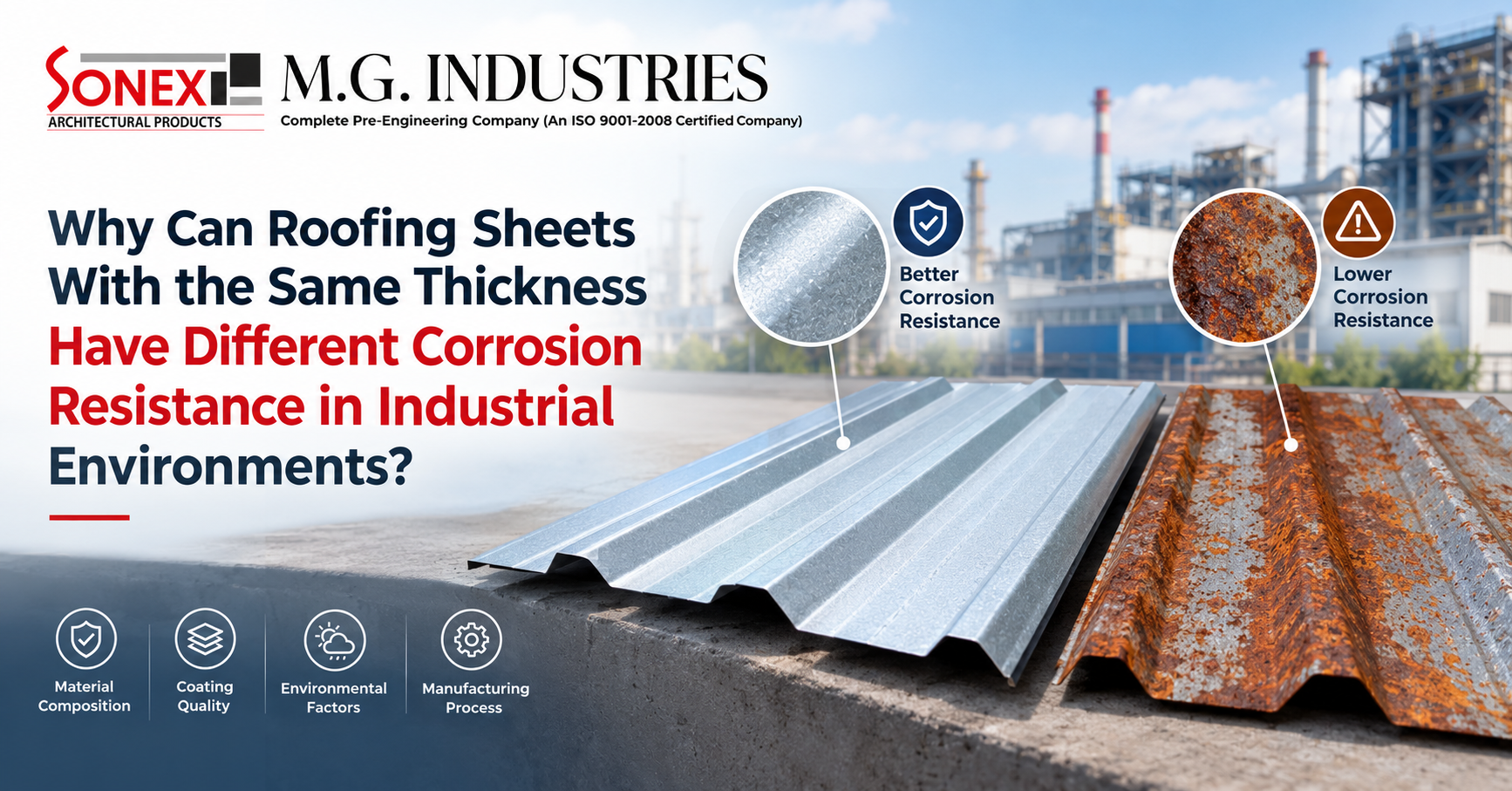
With respect to roofing materials in an industrial setting, it is not enough to consider their thickness alone. TwoRoofing Sheets that have the same thickness could have varying levels of corrosion resistance due to factors such as coating composition, quality of manufacture, surface protection, and exposure to the elements. These factors affect the durability of the steel against moisture, corrosive gases, and temperature variations.
Corrosion resistance is one of the key factors that must be considered while choosing the right roofing materials for various factories, warehouses, and manufacturing units in India. The sheets may look strong during installation, but their life may be shortened if the coating used on the roof is not compatible with the environment. MG Industries recognizes the significance of material evaluation and selection. Knowing what influences the ability to resist corrosion allows buyers to make accurate comparisons of materials and prevent early damage in their purchase decisions.
It is one of the major reasons why two pieces of equal thickness can behave in different ways. There are often protective coatings that form a protective layer between the steel substrate and the rest of the environment in metal roofing materials. The effectiveness of the protective barrier depends on the nature of the composition, thickness, consistency, and suitability to the specific application. Galvanized Steel is coated with zinc to shield the steel substrate. The zinc acts as a barrier protection and sacrificial protection in some of the exposed areas. The Aluminium-Zinc-Coated Steel is protected with a different protective layer.
However, neither coating can be considered appropriate for all industries without taking into account the actual conditions of exposure. The fact that a steel plate is thicker does not guarantee that it will provide better corrosion protection, especially in case its coating is poor. Buyers should take into account both the coating requirements and the metal thickness.
2. Coating Thickness and Composition Affect Performance
Steel thickness and coating thickness are separate measurements. Steel thickness refers to the thickness of the metal substrate, while coating thickness or coating mass indicates the amount of protective material applied to the surface. Two sheets may have the same base metal thickness but different coating weights. A coating specification that would be more appropriate for the environment in which it is to operate could prove to be more effective at resisting corrosion. There is also the composition and chemical content of the coating. It is important because different coatings corrode steel using different approaches.
In comparing roofing sheets, one should look at the grade of coating, coating weight, and relevant technical specifications rather than just looking at the description, which may be heavy duty or premium quality. It is also necessary to establish if the stated thickness is the base metal thickness or the total thickness of the coated sheet.
3. Industrial Environments Can Increase Corrosion Risk
The environmental circumstances that are experienced in industrial buildings are quite different from residential ones. Based on their geographical locations and the operations around them, roofs could be exposed to moisture, chemical pollution, particle pollution, and variations in temperatures. High humidity would ensure that there is water available on the roof surfaces for a long time, making it easy for corrosion to happen. The pollutants from the industries could be deposited on the roof, with some chemicals accelerating corrosion by compromising protective coats. Another environmental issue is the salt that may become airborne in coastal regions, which would mean a coating that is different from one that might be required inland. Some of the key environmental aspects to consider before choosing roofing materials include:
Coastal exposure: The salt deposits may accelerate the chances of corrosion due to an improper or damaged coating system.
Chemical exposure: Industrial exhausts and other chemicals may be corrosive to the protective coating.
High humidity: Moisture on the surface for long periods may cause corrosion.
Contamination of dust: The deposited dust particles may trap moisture and cause corrosion.
Temperature fluctuation: Temperature variations may also lead to condensation, especially on metallic surfaces.
The right material is dependent on the existing situation at the site of installation. A manufacturing plant that handles corrosive chemicals may need a higher degree of protection than a standard storage plant.
4. Manufacturing Quality and Surface Preparation Matter
In spite of the same level of sheet thicknesses and coatings, there can be discrepancies in their corrosion protection because of the different qualities of manufacture. Prior to the use of any protection coating, the steel surface should be properly prepared. Contamination or other issues with the surface can influence the application process of coating. The failure of the coating to properly adhere to the substrate material can make steel sheets even more exposed to the influence of the environment. Consistency is another issue that should not be overlooked.
Defects cannot always be spotted through a cursory examination by eye. Thus, buyers are advised to check out available technical data concerning quality requirements rather than relying only on the look of the material. It is a good idea to ask suppliers about the thickness of the base metal, composition of coatings, weight of coatings, standards of the product, and inspection procedures. This allows a more objective comparison of competing materials.
5. Installation and Maintenance Influence Roofing Performance
Corrosion resistance does not rely solely on the supplied material. Installation and maintenance can also affect the performance of a roof. In the process of transportation and installation of the metal sheets, there can be formed scratches and damage at the edges. The cutting, drilling, and fastening operations can also create areas that are vulnerable to corrosion if done incorrectly. Those areas need to be treated properly. There is also the issue of the design of the roof and its installation. The poor design of the roof can lead to the accumulation of water in some areas. Inappropriate detailing can also make some areas more susceptible to moisture.
Inspections on a regular basis help to locate any damage, spots of corrosion, accumulation of waste material, and drainage problems before these problems become even worse. The methods employed for cleaning should be compatible with both the type of coating system used and the type of contamination existing, especially in case of industries where chemicals may deposit as waste.
6. Why Roofing Sheets With the Same Thickness Can Have Different Lifespans
The lifespan of a roof material is determined by several factors working together. The thickness alone cannot be used to determine the lifespan of a sheet of material. Suppose you have two sheets of steel that are made of the same base metal thickness. The first sheet has a coating that can withstand a moderate environment, whereas the second sheet has a coating that is best suited for a harsher environment. In an industrial environment with high humidity, the second sheet is likely to offer more corrosion resistance if its coating is suited for the prevailing conditions. Suppose you have two sheets of materials with similar coating requirements, but one is scratched during installation. The scratched sheet is likely to corrode faster than the other. The key factors include:
Factor
Effect on corrosion resistance
Base metal thickness
Influences structural properties and the amount of steel available before section loss becomes significant.
Coating composition
Determines how the surface is protected under different environmental conditions.
Coating mass
Influences the amount of protective coating present.
Surface condition
Scratches and coating defects can expose the underlying metal.
Installation quality
Affects the risk of coating damage and moisture accumulation.
Maintenance
Helps identify and manage corrosion risks during service.
It is important to consider all of these factors in the comparison of any products. The service life is dependent on many variables, such as exposure and installation, making it impossible to predict accurately based on only thickness.
7. How to Select Roofing Sheets for Industrial Buildings
Selection of the appropriate roofing materials can be started by identifying their intended environment. The purchaser should first note the level of humidity, coastal salt, and any other conditions leading to corrosion. Once this has been determined, look at the technical data of the materials available for the job. Consider the thickness of the base metal, the coating method, mass, and relevant standard(s). In cases where the corrosion is more severe, contact the manufacturer or technical personnel to find out the right coating system to apply. Other aspects that need to be identified include the installation procedure to maintain the protective coating.
Price can also be another important aspect of choosing materials, but it must not be the sole basis of decision-making. In this case, a lower cost does not mean that it is the most economical material in terms of its compatibility with the environment and the maintenance frequency. A practical process of material choice will involve material specifications, environmental factors, installation needs, and maintenance needs. In this way, it will become easier to find a roof material that will correspond to the building’s needs.
8. Common Mistakes to Avoid When Comparing Roofing Materials
It is wrong to consider that steel products with thicker sheets have greater resistance to corrosion. Thicker steel sheets might have some advantage, but this does not necessarily mean that the coating applied to them is superior. An incorrect approach is also the belief that all coated steel products are the same. This is not true since various coating materials with various weights of coatings react differently in specific conditions.
Also, buyers have to be aware of neglecting the installation quality. Even a good product will deteriorate sooner than it should because of a bad coat, moisture accumulating on the roof, or harmful deposits being left on the surface. Last but not least, choosing the product based solely on how it looks or how cheap it is is definitely not a good decision.
Conclusion
However, even two sheets made of metal that are equally thick can exhibit differences in their resistance to corrosion depending on the differences in the protective coating, the quality of manufacture, the surface condition, and the environmental exposure. In the case of industrial buildings, the choice of Roofing Sheets cannot be made only by comparing sizes and cost. One should also consider other factors.
MG Industriesadvocates that industrial buyers evaluate these factors before making their final choice of materials. A comparison of technical specifications and knowledge of the risk factors prevailing at the site of installation will assist companies in making sound decisions regarding their roofing needs. In this regard, companies should consider the suitability of the material over its thickness.
Frequently Asked Questions
Metal sheets may differ in coating composition, coating weight, quality of manufacture, and surface condition. Such factors affect the ability of metal sheets to resist moisture, chemicals, and pollutants.
Corrosion may be caused by the presence of moisture, high humidity, the presence of salt in the air, chemicals in the form of fumes, and industrial pollutants. This all depends on the conditions.
No, it is not necessary. Thicker sheets have certain advantages, but protection against corrosion also matters.
Protective coatings prevent any physical contact between the steel and the corrosive material. This is determined by the nature of the coating applied.
Industrial buyers should choose materials according to the environment in which they will be used. They should make sure that the technical specifications have been met and that there are regular inspections.
 20/6 Nuchem Compound, Mathura Road, Faridabad.
 sonexdecor@gmail.com
 +91 9599213709