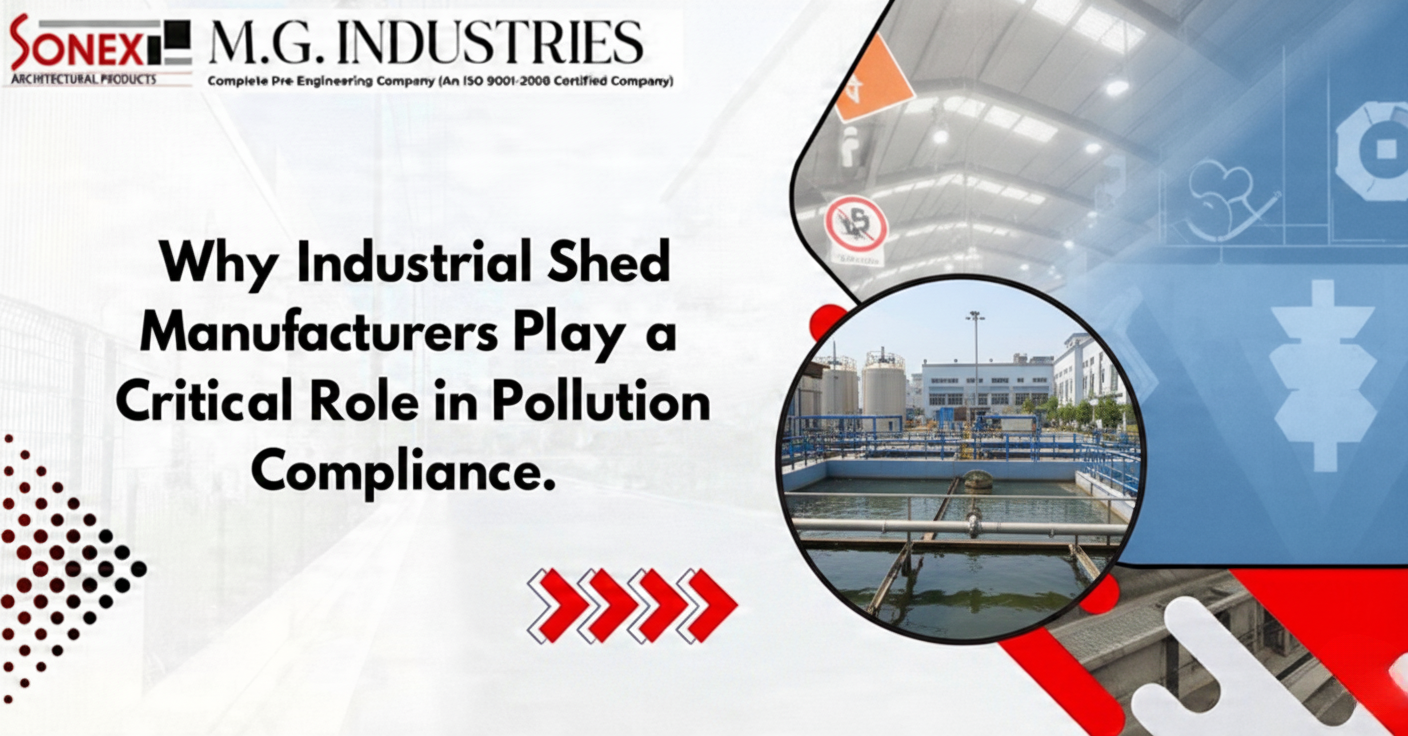
In the modern regulatory environment, industrial expansion and environmental responsibility should go along in each other. With stricter standards on pollution control, industries are likely to contain their emissions, handle their wastes properly, and have facilities that meet environmental clearance standards. Manufacturers of industrial sheds are very critical in this process, as they design and supply structures that facilitate the pollution control systems and regulatory compliance, and allow sustainability of the industrial activities at the very foundation of the ground.
The industrial sheds in modern times are not defined as mere enclaves of production lines and machinery. These are designed spaces in which the air quality, waste movement, sound management, and energy conservation are put into consideration. Industrial shed manufacturers can assist businesses to comply with statutory requirements and, at the same time, operate efficiently by incorporating pollution control factors in the design and construction of sheds.
How Industrial Shed Manufacturers Enable Pollution Control Compliance Through Design and Engineering
Compliance with pollution control is not only done by the use of standalone equipment but also by the infrastructure that supports and improves the environmental management systems. The industrial shed makers come into play by instilling compliance-oriented design and layout, as well as the choice of materials of industrial structures, thus ensuring that the pollution control efforts take effect in the life cycle of the facility.
Designing Sheds That Support Air Pollution Control Systems
Proper management of air pollution starts with shed designs that can fully cover and fit filtration, ventilation, and exhaust into their service without failure to their operations.
- Sufficient height of roof and clear spans to install scrubbers, ducting, and chimneys.
- Heavy air filtration/emission control equipment support.
- streamlined airways corridors to avoid any accumulation of pollutants within the workspaces.
Facilitating Proper Ventilation and Air Circulation
Poor ventilation increases the concentration of pollutants and regulatory non-adherence. This is handled by planning ventilation by the manufacturers of industrial sheds.
- Natural ventilation system to minimize the use of mechanical exhaust.
- Installation of exhaust fans, louvers, and ridge ventilators for effective air exchange.
- Architectural design in accordance with the indoor air quality standards required by the authorities.
Structural Planning for Waste and Effluent Management
The process of pollution control is not limited to the quality of air only, but also includes solid and liquid waste. Shed design plays a direct role in the effectiveness of waste management.
- Separate areas of effluent treatment plants and wastes.
- Oblique flooring and drainage pathways to regulate the flow of wastewater.
- Future expansion of waste management systems structural allowance.
Noise and Vibration Control Through Shed Design
The compliance parameter that is a critical issue is noise pollution in the industrial cluster around residential areas.
- Absorbing wall and roof finishes.
- Physical isolation of very noisy equipment.
- Design buffers, which lessen the vibration transmitted to the neighboring areas.
Supporting Installation of Pollution Monitoring Systems
Governmental organizations are becoming more strict in demanding uninterrupted observation of emission flows and waste characteristics.
- Special provisions for installing monitoring sensors and control panels.
- Inspection and maintenance of accessways that are safe.
- Space planning of data logging and compliance report systems.
Material Selection That Reduces Environmental Impact
The selection of materials is crucial in the long run for environmental conformity.
- Non-corrosive materials that do not leak and cause contamination.
- Emissions from roofs and cladding materials are low-emission.
- Resistant finishes that slow down the replacement and manufacturing of waste.
Enabling Energy Efficiency and Emission Reduction
Green buildings play a direct role in the decreased level of pollution.
- Solutions that lessen the artificial lighting demand through daylighting solutions.
- Roofs that can accommodate the solar panel.
- Thermal insulation to reduce HVAC use of energy use.
Ensuring Compliance with Environmental Clearance Conditions
Structural and operational conditions are common with environmental clearances.
- Design conformity with accepted environmental layout.
- Organizational preparedness to control pollution upgrades.
- Consensus to operate and consent to establish conformity.
Reducing Risk of Regulatory Penalties and Shutdowns
Failure to comply may lead to fines, lawsuits, or closure. These risks are alleviated by industrial shed producers.
Compliance-first design eliminates inspection failures.
- Streamlined audits through planned layouts and access points.
- Operations that are long-term stable with no frequent revisions.
Supporting Sustainable Industrial Growth
The infrastructure required by industries that wish to survive in the long term must be updated according to the regulations.
- Fluid designs that conform to shifting pollution standards.
- The reduced lifecycle environmental impact.
- Better corporate environmental responsibility profile.
Conclusion
Compliance is no longer considered a choice in addressing pollution control and is now an essential mandate in the way industries are run. The role played by industrial shed manufacturers is very important since they design and build facilities that are actively involved in the support of air, water, noise, and waste management systems. They help industries to achieve the set environmental regulations sustainably and efficiently through smart layout planning, choice of materials, ventilation, and infrastructure that is compliant. Through collaborations with established organizations such as MG Industries, businesses can come up with industrial sheds that are not only capable of fulfilling the requirements of the pollution control standard but also help businesses operate efficiently over the long term and be responsible in the growth of industries.
 20/6 Nuchem Compound, Mathura Road, Faridabad.
 sonexdecor@gmail.com
 +91 9599213709