Enter a modern airport, corporate building, shopping complex, manufacturing facility, or subway station, and you will find one design component that silently speaks without being too prominent—the ceiling. When tourists admire the lighting, spaciousness, and interior decoration of the building, few would know that the ceiling above is playing a much more important role.
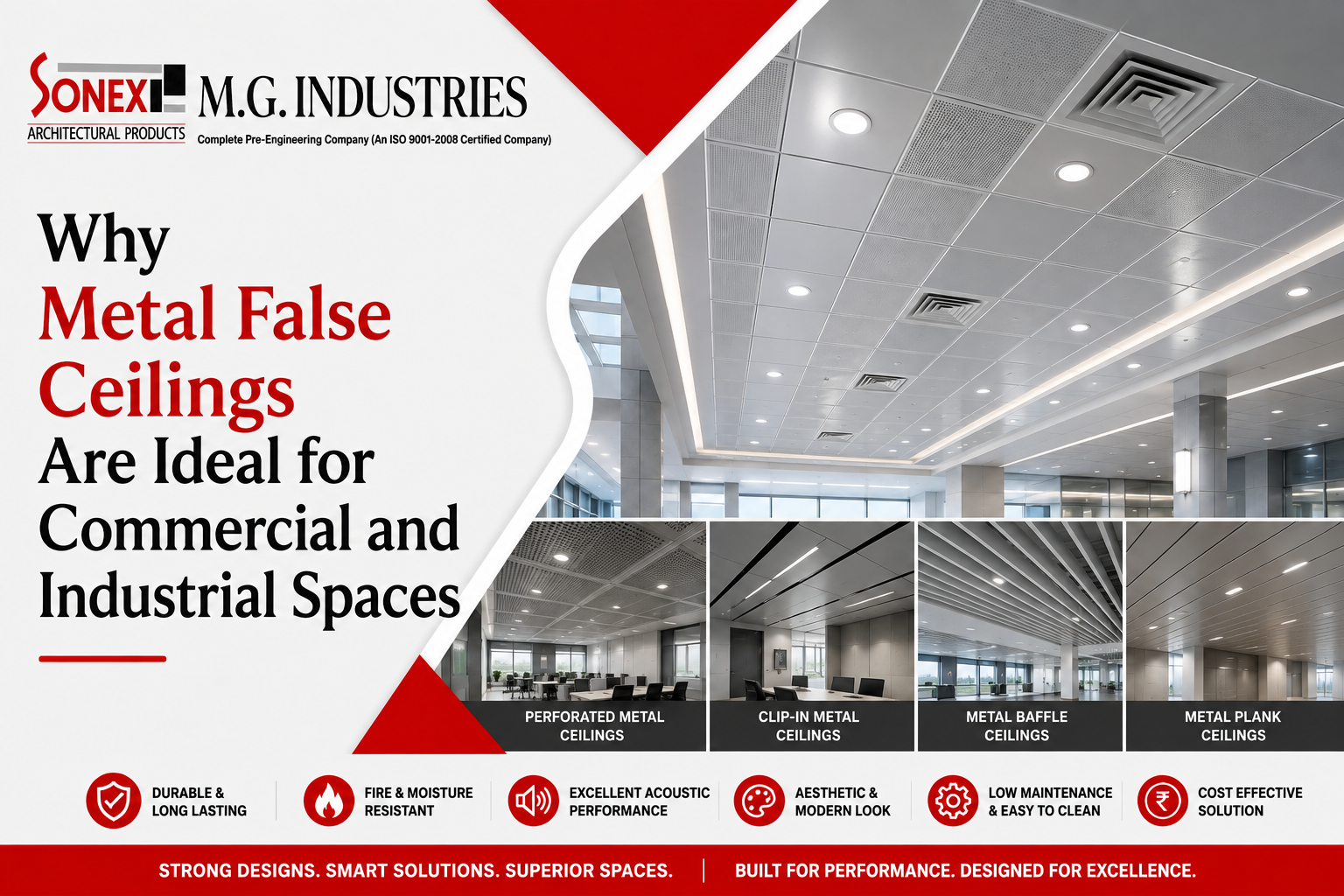
The selection criterion for the ceilings is no longer based on their aesthetics alone; the need for safety, easier maintenance, better energy efficiency, and durability has increased. It is this increasing need that has led to the popularity of Metal False Ceilings for Commercial Spaces.
Industry Insight
The commercial construction industry has evolved immensely in the last decade. Developers are supposed to provide buildings that not only look good but also function well, and at the same time, save money on maintenance.
Standard building materials cannot withstand humidity, dust, high temperatures, and the continuous running process. With businesses becoming more interested in lifecycle costs than installation costs alone, metal ceilings have emerged as a better choice.
Metal false ceilings in commercial spaces are being used in airports, hospitals, educational institutes, office buildings, factories, shopping centers, hotels, and industries because of their durability in tough situations.
The rising trend of green buildings and sustainable construction has made the use of recyclable metal ceilings very popular.
Expert Commentary
From an architectural and engineering perspective, ceiling systems influence much more than interior appearance. They affect acoustics, lighting efficiency, maintenance accessibility, ventilation, and fire safety.
Industry professionals generally recommend metal ceiling systems for buildings where long-term operational efficiency is a priority.
Some of the key reasons include:
- Excellent structural durability
- High resistance to moisture and corrosion
- Better fire performance than many conventional materials
- Easy integration with lighting, HVAC, and sprinkler systems
- Minimal maintenance requirements
- Modern architectural appearance
Another significant advantage is flexibility. Metal ceilings are available in different panel sizes, finishes, colours, and perforation patterns, allowing designers to balance aesthetics with functionality.
For facilities that require frequent maintenance access, modular ceiling panels also simplify inspections without damaging the ceiling structure.
Proof & Real-World Perspective
Across India and many international markets, commercial infrastructure projects increasingly favour metal ceiling systems because of their ability to perform consistently in high-traffic environments.
Consider a busy airport terminal. Thousands of passengers move through the building every day, while lighting systems, ventilation equipment, electrical wiring, and fire safety infrastructure operate continuously above the ceiling. In such environments, ceiling materials must allow easy maintenance access while maintaining a clean, professional appearance.
Similarly, manufacturing plants often generate dust, heat, humidity, or chemical exposure that can shorten the lifespan of traditional ceiling materials.
Metal ceiling systems perform better because they resist warping, cracking, and moisture damage. Healthcare facilities provide another practical example. Hygiene is critical, making easy-to-clean ceiling surfaces an important operational requirement.
Retail environments also benefit from reflective ceiling finishes that enhance lighting while creating a brighter shopping experience.
These practical applications demonstrate why Metal False Ceilings for Commercial Spaces have become a preferred investment across multiple industries.
Analysis
Choosing the right ceiling system requires evaluating long-term building performance rather than simply comparing initial costs.
Key Benefits
- Long operational lifespan
- Corrosion resistance
- Fire-resistant properties
- Modern architectural aesthetics
- Low maintenance costs
- Recyclable materials
- Easy cleaning
- Better acoustic options
- Compatibility with HVAC systems
- Professional interior finish
Common Challenges
Even premium ceiling systems require proper planning.
Potential issues include:
- Selecting the wrong panel specifications
- Poor installation practices
- Ignoring acoustic requirements
- Choosing materials unsuitable for the building environment
These challenges can usually be avoided by working with experienced manufacturers and installation professionals.
Common Mistakes
Many project owners focus only on product pricing.
However, they often overlook factors such as:
- Product quality
- Manufacturer reputation
- Installation expertise
- Maintenance accessibility
- Warranty support
- Future expansion requirements
Looking beyond upfront costs generally produces better long-term value.
Recommendations
Selecting the right ceiling system should begin with understanding how the building will actually be used. Industry experts recommend considering the following before making a purchase.
Evaluate Building Usage
Different facilities require different ceiling specifications.
Office buildings prioritise aesthetics and acoustics, while factories require durability and easy maintenance.
Verify Material Quality
Choose ceiling systems manufactured using high-quality aluminium or steel with durable protective coatings.
Consider Fire Safety
Commercial buildings should prioritise ceiling systems that support fire-resistant construction standards.
Think Long-Term
Evaluate lifecycle costs instead of only installation expenses.
Higher-quality ceiling systems often reduce maintenance and replacement costs over many years.
Choose Experienced Manufacturers
An experienced supplier provides technical guidance, quality assurance, customised solutions, and dependable after-sales support.
A carefully planned investment helps improve building performance while protecting long-term operational budgets.
Closing Thoughts
Modern commercial and industrial buildings demand interior solutions that combine functionality, durability, and architectural appeal. Metal False Ceilings for Commercial Spaces successfully meet these expectations by offering excellent structural performance, low maintenance, fire resistance, and design flexibility. Whether the project involves an office complex, healthcare facility, airport, retail space, or manufacturing unit, metal ceiling systems provide long-term value that extends well beyond aesthetics. By partnering with an experienced manufacturer like MG Industries, businesses can invest confidently in ceiling solutions that enhance building performance, improve operational efficiency, and support sustainable infrastructure for years to come.
 20/6 Nuchem Compound, Mathura Road, Faridabad.
 sonexdecor@gmail.com
 +91 9599213709